
Why are kids buying food they can’t eat?
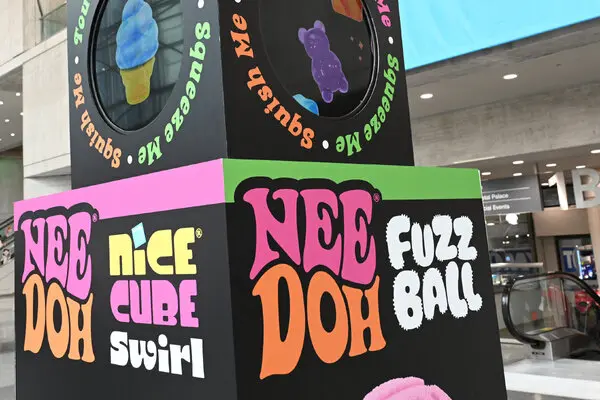
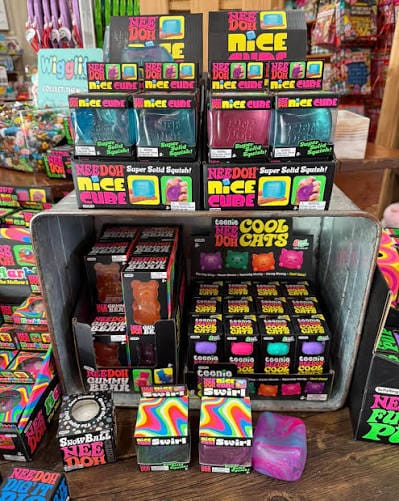
Somewhere in a Target near you there is a $9 stick of butter that nobody will ever spread on anything. It is slow-rise foam, about the density of a marshmallow, and its whole job is to get squeezed on camera for four seconds. Next to it sits a cheese cube with the same job. A few aisles over, a gel-filled orb called a NeeDoh is out of stock again, as it has been on and off since last winter.
If you have a kid, a niece, or a TikTok account, you have watched the toy aisle turn into a fake grocery store: foam croissants, mochi, dumplings, avocados, toast, boba. Soft, cheap, and none of it edible. The instinct is to blame the children. The data does not cooperate.
Circana, the industry’s main sales tracker, had U.S. toy dollar sales up 13 percent through April, with squishy toys posting triple-digit growth in both dollars and units. Buyers eighteen and older drove more than a third of that growth. Purchases for women accounted for more than half of it. By June the year had become the strongest first half for toys in six years — dollar sales up 17 percent — and adult-only households were ringing 55 percent of every toy dollar. Sales to adults grew 25 percent. Sales to teenagers grew 33. Together they produced nearly 60 percent of the industry’s new money.
Kids are buying squishies. The category exploded because adults are buying them too: at their desks, in their cars, as a ten-dollar answer to a bad afternoon. The industry calls these buyers kidults. It has spent most of a decade rebuilding itself around them. To understand how a grown woman ends up squeezing a foam croissant at a red light, you have to go back to the store that used to decide what a toy was.
*
Toys “R” Us was the industry’s research department. Jefferies estimated that in its last full year the chain took 15 to 20 percent of every toy dollar spent in America. The volume mattered less than the format. The stores carried enormous, year-round assortments and gave shelf space to products nobody had proven yet. A manufacturer with a strange idea had exactly one place where a kid could stumble across it, pick it up, and beg.
The chain filed for bankruptcy in September 2017 and liquidated its U.S. stores by June 2018. KB Toys had already died in 2009. FAO Schwarz had closed its flagship in 2015. Toys “R” Us was the last dedicated toy chain operating at national scale, and then there were none.
The damage showed up within months. NPD recorded a 2 percent drop in U.S. toy sales in 2018 — the first decline after four years of growth — and another 4 percent in 2019. Plush fell 10 percent that first year. Building sets fell 5. Outdoor and sports toys fell 4. Those were the categories that needed a kid’s hand on a shelf. Stephanie Wissink at Jefferies looked at the 2018 holiday quarter and figured other retailers had recaptured only about 35 percent of the share Toys “R” Us left behind. The rest did not migrate. It vanished with the aisle.
Walmart, Target, and Amazon took the volume. Walmart expanded its in-store toy selection by roughly 30 percent and its online assortment by 40. Target added about 250,000 square feet of toy floor, nearly double what it had devoted the year before. CEO Brian Cornell called the closure “unique opportunities” to capture share and drive trips. By 2020, IBISWorld had Walmart at 23 percent of the U.S. toy market and Amazon at nearly 20.
They took the volume. Nobody took discovery. Mass merchants run toys as a seasonal traffic driver, weighted to the fourth quarter, stocked with proven franchises, licensed characters, and whatever turns fastest. The experimental, year-round assortment that let an odd product find its audience shrank to a few endcaps. A manufacturer with an unproven idea no longer had a shelf in America where a child could find it by accident. Discovery moved to a screen.
*
While the stores were dying, a particular kind of video was taking over YouTube and Instagram: slow-motion squeezing, slime stretching, kinetic sand slicing. The genre was called satisfying content, or ASMR, and most of its raw material came from Japan. The original squishies were stationery-store accessories — slow-rise polyurethane foam shaped like bread, fruit, and cake, sold in Tokyo gashapon machines as stress relievers, never as toys. Western teenagers found them through “squishy haul” videos around 2015. By 2018, U.S. sales had reportedly crossed $100 million, on the same tactile impulse that produced the fidget spinner. Then the knockoffs arrived, the foam stopped rising properly, the trend died around 2019, and the collectors who stayed moved to Discord and Etsy.
Most trend pieces skip this. The current boom is a revival. The foam food has existed for a decade. The machine around it is what changed.
Two products launched into that collapse in 2017 and became the bridge out of it. One was NeeDoh, a gel-filled “Groovy Glob” from a small Massachusetts company called Schylling. The other was Squishmallows.
Kellytoy, a Los Angeles claw-machine plush maker, put eight Squishmallow characters on Walgreens shelves in 2017. For three years they were a footnote. In April 2020, weeks into lockdown, Jazwares bought the company. Stuck at home and scrolling, teenagers and young adults turned the plush into TikTok’s comfort object. Hauls, “squishmallow checks,” and rare-character hunts piled up views in the billions. Jazwares built a machine on top of that attention: thousands of named characters with backstories, retailer exclusives, manufactured scarcity. The brand sold 100 million units in 2022 alone. By August 2024 it had sold 400 million across 3,000 styles. It won Toy of the Year three years running. Warren Buffett’s Berkshire Hathaway inherited the whole thing, almost by accident, when it bought the insurer Alleghany for $11.6 billion in 2022.
Jazwares’ co-president put it plainly: “It’s not just kids, it’s adults.” A plush toy could be a collectible, a comfort object, and a piece of social-media content at once, and the buyer could as easily be twenty-four as eight. The same shift was showing up everywhere. In the first four months of 2024, Circana found that adults had overtaken preschoolers as the single largest toy-buying age group in America, spending $1.5 billion in that window. Pokémon cards, LEGO’s adult sets, Funko, blind boxes, Pop Mart’s Labubu: all of it sold to the same people. Adults have the discretionary income kids don’t. A rough decade handed them reasons to spend some of it on something soft.
Which is how we got back to the butter.
*
A modern squishy is a small, cheap, tactile object — foam, gel, rubber, putty — that does one visually obvious thing when you squeeze it. Every word in that sentence also describes an ideal short-form video. Instant payoff. A satisfying loop. A texture and color you understand in the first second. No explanation required. Fully legible with the sound off.
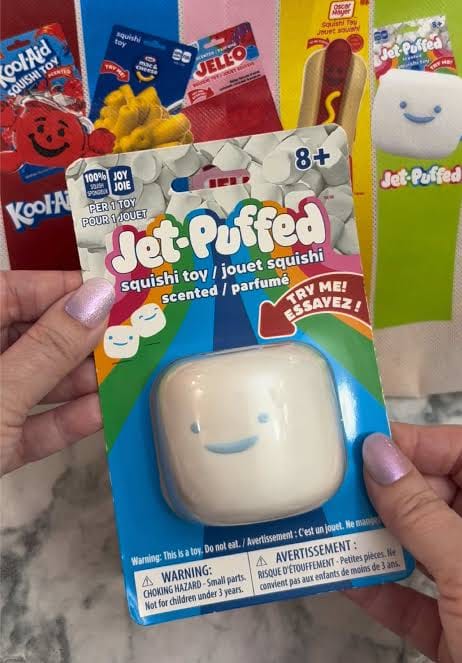
Traditional toy advertising had to convince a child to nag a parent to buy something later at a store. A squishy video collapses persuasion, demonstration, and desire into four seconds aimed at the person holding the phone, and the person holding the phone has a credit card. Food shapes win for the same reason. You already know what butter feels like. Watching a stick of it fold in half is a joke that needs no caption.
The last piece arrived in September 2023, when TikTok Shop launched in the United States and put a checkout button under the video. Before that, seeing a squishy online meant leaving the app, searching, finding a retailer, and buying it days later. Now the creator squeezes the toy, the product is tagged, you tap, you buy, and the algorithm serves you a slightly different one. Momentum Works, working from Tabcut platform data, put TikTok Shop’s U.S. gross merchandise value at $15.1 billion in 2025, up 68 percent in a year. Circana’s independent tracking is colder and more useful: about 1 percent of all U.S. retail and 3 percent of e-commerce, with toys, hobbies, and collectibles as its third-largest category.
The engine underneath is commission. Sellers ship free samples to creators, who earn roughly 5 to 20 percent on every sale their video drives. Industry estimates put creator content behind 60 to 70 percent of U.S. TikTok Shop volume. A squishy video is a paycheck.
The supply side runs at the same speed. Chenghai, a district of Shantou in southern Guangdong, produces roughly a third of the world’s plastic toys. Tens of thousands of workshops sit on top of one another: molds, foam, printing, packaging, export. A white-label foam croissant can go from a Chenghai tool to a U.S. importer to a creator’s hands to a porch in weeks. The Hasbro-to-Walmart pipeline takes a year or more. When a shape starts trending, a hundred lookalikes are on the platform before the original seller has restocked. That is why the shelves feel so repetitive. These products are designed, openly, for the first second of a video.
Speed has a residue. In early September the Consumer Product Safety Commission warned shoppers off a dumpling-shaped “squishy bun” sold on Amazon that packed water beads inside the foam — illegal under the water-bead rule that took effect in March. Schylling, which actually makes the NeeDohs people are hunting, has the opposite problem. It sold through a year’s inventory in the first nine weeks of 2026. Comments from the CEO to The Strategist put this year’s growth at six times last year’s, after 2025 had already doubled 2024. The company started capping retailer orders. In July a California woman sued, alleging a Nice Cube left near a window ruptured when she squeezed it and dumped hot gel on her leg. The brand that cannot keep a shelf full is now also the brand arguing about what “do not leave in sunlight” was supposed to cover.
*
A foam croissant is the cheapest possible object that is soft, funny, instantly understandable, endlessly variable, weightless to ship, trivial to copy, and one tap from the door. It fits the market the toy industry built by accident after Toys “R” Us died: distribution consolidated into three retailers who stock only what is proven, discovery handed to an algorithm, and a customer base increasingly made of adults buying small comforts for themselves.
Tariffs made the math slightly worse for big, heavy, complicated toys and slightly better for small, light ones. They started none of this. Japanese stationery stores and YouTube started it a decade ago. TikTok Shop turned it into a button.
The kids are buying food they can’t eat. So are their parents. Schylling is allocating NeeDoh into 2027. The Chenghai molds are already cutting next season’s shapes.